


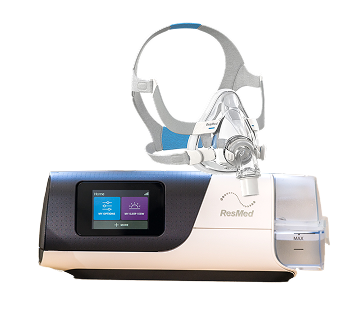



The term CPAP machine refers to a Continuous Positive Airway Pressure machine, which is a form of Positive Airway Pressure therapy or “PAP” therapy. A CPAP machine is the recommended treatment for Obstructive Sleep Apnea (OSA) by the American Academy of Sleep Medicine and can be prescribed by a board-certified sleep specialist or other licensed health care providers.
A CPAP machine provides a constant stream of pressurized air to your nose and/or mouth, which keeps your airway from collapsing while you sleep. This helps you breathe and maintain good blood oxygen levels throughout the night.
Let’s take a closer look at how CPAP machines work, what they look like, the differences between the three types of machines, the benefits and drawbacks, and how to succeed with CPAP therapy.
How Does a CPAP Machine Work?
CPAP devices use room air, which is filtered, pressurized, and humidified before being sent through a tube to a CPAP mask. This continuous stream of pressurized air then flows through the airway, keeping the throat and airway clear of obstructions and stimulating breathing.
When using a CPAP machine, your muscles are no longer blocking the flow of oxygen. As a result, you won’t repeatedly wake up to resume breathing or gasp for air. Ideally, you’ll wake up feeling more refreshed and energized as you continue with your CPAP therapy, though this isn’t the case for everyone. Whether you notice the results or not, however, treating sleep apnea with a CPAP machine will still benefit your overall health.
What Are the Different Types of CPAP Machines?
The three types of machines are CPAP, APAP, and BiPAP, and all three share the same basic components.
Here’s what connects to the CPAP machine and what it looks like:

- Motor: This is what sits on your bedside table. It’s a small, quiet compressor that takes in room temperature air and pressurizes it. The machine delivers the pressurized and filtered air to your airway via a hose and mask. Some people opt to use the humidifier if it comes with the machine, or purchase one to keep their nose, mouth, and throat from getting dry.
- Hose: The CPAP hose connects the machine to the mask. Hoses are specially created to maximize airflow. They are typically six feet long and designed to successfully deliver your therapy. Hoses can also be heated to improve comfort and compliance.
- Tubing Elbow: The elbow adapter connects to the air outlet of the device and angles the direction of the hose and machine to prevent hose kinks from cutting off your airflow while sleeping.
- Mask: Depending on your particular breathing issues and fit requirements, your CPAP mask may go over your nose (nasal mask) or over your nose and mouth together (full face mask). Another style is the nasal pillow CPAP mask, which inserts into the nostrils from below. Masks are easy to use, but comfort will vary depending on your preferred sleeping position, body type, and amount of facial hair as well as other variables. Therefore, it’s best to try different types of CPAP masks until you find the one that’s most comfortable for you.
- Headgear: The headgear keeps the mask in position and is often made of soft and stretchable material for added comfort.
- Straps: Adjustable chin straps help customize the fit of the device and are often used for those with mouth-breathing habits during sleep.
What Are the Differences Between CPAP, BiPAP, and APAP Machines?
As you browse through various sleep apnea machines online, you’ll likely come across three different types of machines. Ultimately, your sleep technician or doctor will work with you to decide what machine is best for you.
Watch our video explaining the differences between the three types of machines.
https://www.youtube.com/watch?v=Rsr8mPble4s
A Quick Comparison of CPAP vs BiPAP vs APAP:
CPAP: CPAP stands for “Continuous Positive Airway Pressure” and is set at one specific pressure setting between 4 and 20, and that pressure is used at all times. If you actually need more or less pressure during the night, the CPAP is not able to adjust.
BiPAP: A BiPAP, also known as a BiLevel machine, is an acronym that stands for “BiLevel Positive Airway Pressure” and operates at pressure settings between 4 and 25. They are unique in that they have two pressure settings—one for inhale and one for exhale.
BiPAP machines are typically used to treat Central Sleep Apnea, as they can prompt breathing. This is also helpful for other conditions affecting the lungs, such as COPD. They can also be set at a pressure setting higher than 20 if it is required.
APAP: APAP stands for “Automatic Positive Airway Pressure” and will adjust the pressure on a breath-by-breath basis. APAP machines operate in the same range of pressures between 4 and 20, but unlike CPAP machines, they can automatically choose the right pressure setting based on your breathing needs. This allows for much better flexibility and is largely why APAP machines are so popular today.
The Pros and Cons of Using a CPAP Machine
As with any treatment, there are pros and cons associated with treating sleep apnea using a CPAP machine. But, the benefits far outweigh ignoring the treatment of this sleep disorder. Let’s discuss the benefits before offering solutions to the common side effects and problems associated with CPAP treatment.
Health Benefits of Using a CPAP Machine
In addition to treating Obstructive Sleep Apnea (OSA) and snoring, CPAP therapy helps treat several other health conditions and issues including:
- Blood Pressure. Studies show that patients with hypertension experienced a decrease in blood pressure while using a CPAP.
- Heart Disease. A study found that cardiovascular events decreased in those with coronary artery disease (CAD) as a result of using a CPAP.
- Depression. CPAP wearers who use their machine nightly for at least seven hours reported feeling less depressed and more alert during the day.
- Reducing Stroke Risk: Strokes are also associated with sleep apnea. Meta-analyses reported that more than 50% of those who have had a stroke suffer from moderate to severe sleep apnea.
- Upper Airway Resistance Syndrome (UARS). A form of sleep-disordered breathing, UARS is the stage between mild snoring and full sleep apnea. When your airway reduces in diameter due to loose tissue, this constriction creates resistance. Air still moves into your lungs but not as easily. You may not experience apnea events where you stop breathing, but your sleep breathing will be heavy and labored. As you work harder to breathe, your brain may compensate by waking you up. Left untreated, UARS almost always develops into Obstructive Sleep Apnea (OSA). CPAP therapy is not necessarily the first line of treatment for UARS, but as the condition progresses, it’s often recommended to help keep the airway open.
Drawbacks and Solutions to Common CPAP Side Effects:
For regular CPAP wearers, there will always be problems that come up. Here’s a quick rundown of these issues, and what to do about them.
Dry Mouth: Sometimes, dry mouth can be caused by mouth breathing or from not using a CPAP humidifier. If you naturally breathe through your mouth during sleep, dry mouth can easily be fixed by using a humidifier. The humidifier adds moisture to your dry therapy air. It can also prevent nasal congestion or a runny nose.
Mask Leaks: Masks don’t always fit properly, and sometimes, your sleeping position can cause the airtight seal to break, allowing much-needed therapy air to escape. Mask leaks make a lot of noise and can be trouble for light sleepers. Mask leaks aren’t just annoying; they can make your therapy less effective and cause your sleep problems to worsen.
Sometimes all you’d need to do is tighten the mask, and that could fix the problem. If that doesn’t work, it could be the pillow, pressing up against the mask and causing the seal to break. To fix this issue, consider purchasing a CPAP pillow. These specially designed pillows have spaces cut out to accommodate your mask so that it doesn’t break the seal and cause a leak.
Water in the Hose: A heated humidifier gently heats the water in the humidifier tank, causing it to evaporate. As it travels down the tube, the air cools and can no longer hold the moisture.
The moisture then falls out and often winds up in the tube. This can lead to uncomfortable splashes during the night. The solution, in most cases, is to make sure the warm air stays warm. This can be done with a heated hose or hose cover. Both products help keep the air warm as it travels to the airway, and this, in turn, prevents splashes.
For more solutions to common CPAP problems, check out the following article: Easy Remedies to the 19 Most Common CPAP Problems
How and Where to Get a CPAP Machine
There are two ways most people get their CPAP device:
- Through an Insurance Provider
- By Buying Online
Since insurance covers most sleep apnea machines, why would anyone pay out of pocket for a machine and buy online?
The easiest answer to this complicated question is simple: most of the time, insurance companies won’t pay for CPAP machines if you haven’t met your deductible, meaning you’ll be renting it to begin with and oftentimes, paying much more than what the machine costs.
Buying a CPAP online is a lot less expensive, and if you’re going to have to pay out of pocket anyway, most people would prefer to pay less and get a better machine than what the insurance company is willing to provide.
Insurance companies also keep track of your nightly therapy usage, and if they don’t feel like you’re using the machine often enough, they’ll ask for you to give it back. When you buy a machine online, the online seller doesn’t track or look at your sleep data. It’s usually only shared with your physician. The online seller also won’t repossess the machine once you’ve bought it. It’s yours, no matter how much (or little) you use it.
Insurance companies also have little incentive to give you the best machine for the price you pay and will oftentimes not give you a quality machine. When you forgo insurance and pay cash, you’ll not only get a lower price but you’ll likely get a better machine of your choosing.
Do You Need a Prescription for a CPAP Machine?
This is a common frustration among those who have been newly diagnosed with sleep apnea. Federal and State law requires a doctor’s prescription to be on file before a CPAP machine can be sold to a customer. This is because a CPAP machine is considered a Class II Medical Device, which is a medical implement that requires a doctor’s care before and while using.
Examples of Class II Medical Devices are CPAP machines, BiPAP machines, APAP machines, Oxygen Concentrators as well as CPAP masks.
For more information on this topic, please see this resource from the FDA about device classification and regulation.
How to Get a CPAP Prescription:
While your health care provider can write a prescription for a CPAP machine, it’s a better idea to see a sleep specialist and do a sleep study. Technology has advanced so much recently that a sleep study can now be done 100% at home, with no need to spend the night at a sleep lab.
The sleep study will determine your level of sleep apnea—mild, moderate, or severe—based on the number of breathing stoppages that occur per hour, also known as your Apnea-Hypopnea Index or AHI. From that information, the sleep specialist can prescribe the best pressure to treat your sleep apnea.
When you buy your machine from CPAP.com, we will set the pressure based on your doctor’s orders. Once CPAP.com has your prescription on file, you don’t have to submit it again. We’ll safely and confidently store it for you so that when you’re ready for your next purchase, you can buy it quickly and easily.
Related reading: Looking for the best CPAP machine? We’ve got you covered! Read our Best CPAP Machines of 2021 guide to find your perfect match.
Tips for Getting Started With CPAP Therapy
The first step is to get a diagnosis. To confirm you have sleep apnea, you’ll need to visit your primary care physician (PCP) or health care provider to receive a referral to a sleep doctor. They will advise you to complete a sleep study (polysomnogram), which is conducted either at a sleep clinic or through an at-home sleep study.
The polysomnogram is an overnight test that allows sleep technologists to collect comprehensive data about your sleep, such as your brain activity, blood oxygen levels, heart rate, and respiration. If you do have sleep apnea, sleep lab technologists will be able to track how often you stop breathing per hour of sleep.
In a home sleep study, a sleep lab will send you easy-to-use equipment that you can attach to yourself before sleeping at night. It records your pulse and breathing rates. You simply detach it from yourself in the morning and send the equipment back to the lab for analysis. The results of either test are sent to your specialist who will meet with you to determine a course of treatment.
If the sleep specialist prescribes you a CPAP, you may need a follow-up sleep titration study. This is a second overnight visit to the sleep center to determine which machine and mask are right for you as well as the correct CPAP pressure settings. During this visit, you will sleep while trying a few different CPAP masks and machines to determine the one that is most comfortable for you. The sleep technician will test different air pressure calibrations to determine a level that will clear your airway of obstructions without disturbing your sleep.
How to Use a CPAP Machine:
Using a CPAP Machine is simple. Follow these easy steps, and you’ll be on your way:
- If you’re using a humidifier, fill the chamber with distilled water and place it in the machine. You’ll always want to do this step first. You’ll also want to make sure you only use distilled water. Using tap water can leave a chalky film at the bottom of your humidifier, making it harder to clean. If you’re absolutely in a pinch, bottled or tap water is okay to use from time to time, especially if boiled first. Just make sure you clean your CPAP correctly after each use.
- Many machines include a ramp feature that allows you to start the night at a lower therapy pressure and ramp up over time to your prescribed pressure, making it easier to fall asleep. Decide if you’re going to use this feature and if so, make sure it’s set up on your machine.
- Slide the mask into place by starting with the headgear. For most masks, you would slide the headgear over the back of your head and then position the cushions and the frame.
- Clip or attach the headgear to the frame as necessary.
- Turn on the machine.
Getting Used to CPAP Therapy:
Sleep therapy is a marathon and not a sprint. You need to use your CPAP nightly for the best results. According to a board-certified neurologist and sleep specialist, Dr. Daniel A. Barone, practicing with your CPAP mask during the day can help you better adjust to wearing your CPAP equipment at night. He often makes this recommendation to new patients who struggle to get comfortable with the unfamiliar feeling of wearing a CPAP mask.
Those who stick to their therapy also report seeing improvements in their daily life beyond a good night’s sleep. However, there’s still a variety of reasons why people fail to consistently use their machine, including:
- A Poorly Fitting CPAP Mask
- A Problem With Tolerating the Air Pressure
- Aerophagia—Swallowing Air, Which Can Lead to Gas, Flatulence, Bloating, Burping, or Discomfort
- Humidification Issues (or Lack Thereof), Which Can Lead to Irritations in Your Throat and Mouth
Fortunately, most of these issues can be addressed by having the right equipment and the right settings. If you have any stigmas about using a CPAP, discuss them with your specialist and develop a plan on how to overcome them. Don’t forget that you are making an investment in improving your health, so the best thing to do is to educate yourself and learn how much better you may feel by consistently using your CPAP.
Contact your health care provider if you do not feel like your sleep apnea symptoms are being treated properly, so they can re-evaluate your CPAP equipment and settings. Just like with anything else requiring long-term treatment, treating your sleep apnea is a long-term commitment, meaning you may need to make occasional adjustments and modifications to keep your treatment working for you. The long-term benefits of sleep apnea treatment are worth the effort.
Alternatives to CPAP Therapy
Looking for a CPAP alternative? There are quite a few different options available today. However, not all of the alternatives will work for everyone. Here’s a rundown of some of the most popular treatments.
- Oral Appliances. Many of these devices are designed to hold your tongue in place to keep it from sliding backward in your mouth during sleep. Oral appliances, also referred to as mandibular advancement devices, are made by a dentist and help to open up your airway so that air can reach your lungs. For people with very mild sleep apnea, an oral appliance may be an effective treatment. Oral appliances work by keeping the tongue from sliding backward, but if your problem is a narrow airway or that there’s too much soft tissue in your throat, an oral appliance may do you no good.
- Surgery. In rare cases, your doctor may prescribe surgery to remove excess tissues or improve the geometry of your airway, making it easier to breathe. Surgery is looked at as a last resort and is usually not the first treatment a doctor will recommend.
- Hypoglossal Nerve Stimulator. Hypoglossal Nerve Stimulator is the implantation of an electric stimulator on the hypoglossal nerve, which affects and influences tongue movement. This procedure is increasingly common in patients with Obstructive Sleep Apnea and while it has seen success, it does require invasive surgery and should only be considered after common lifestyle-related solutions have been explored.
- Changing Sleep Positions. Sleeping on your back is the worst position for a person living with sleep apnea. Shifting positions can actually improve airflow during sleep, and in some very mild cases, it can significantly reduce the number of breathing events during the night. The most helpful change in position is actually to sleep on your side. Side sleeping allows gravity to work in your favor, helping the soft tissues of the mouth and throat to open naturally. This means your machine doesn’t have to work as hard—or in some very mild cases even at all. There are plenty of CPAP pillows and side-sleeping solutions to support you in this if you have difficulty staying in particular positions.
The Bottom Line
The truth is, CPAPs do work for many people, helping those that succeed at their therapy live fuller, more productive lives. When your therapy is working, you may notice a difference in your energy levels, which can lead to positive improvements in other areas of your life.
But, like any treatment and as things change in your life, your response to the treatment will change too. That’s why regular communication with your provider is important so that he or she can make adjustments as time goes on, keeping you from missing a beat in your care.
If you want to know if your CPAP is working correctly, you’ll need to look at your data. Interpreting the data can be daunting at first, but we’re here to help. We’ve written two resources: How to Better Understand Your CPAP Results and How to Read CPAP Data. Once you understand what the data means, you can evaluate if your sleep apnea therapy is working.
You may also find our community of helpful CPAP wearers at CPAPTalk who are there to answer your questions on your quest for better sleep.
Want to know how long it will take for CPAP to be effective? Consider reading our article: How Long Before CPAP Helps With My Sleep Apnea?