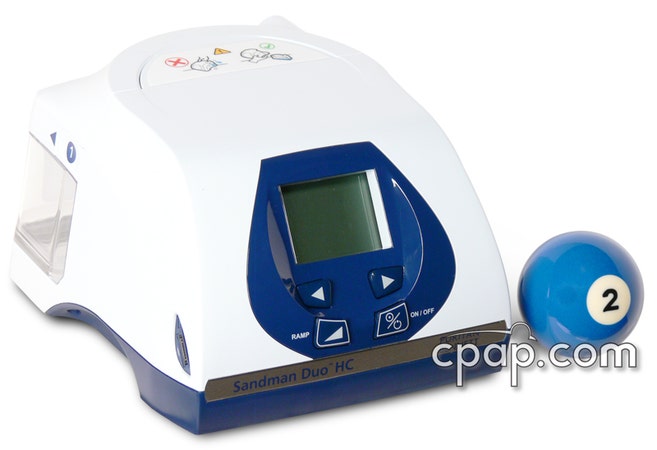
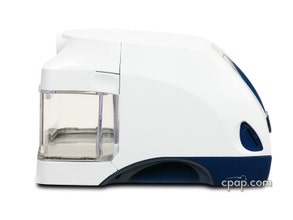
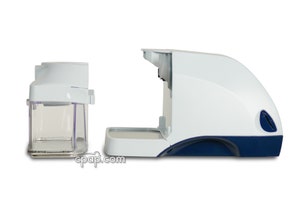
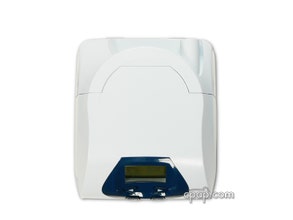
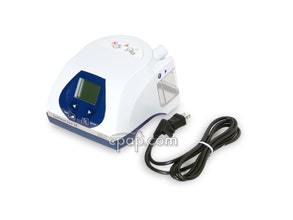
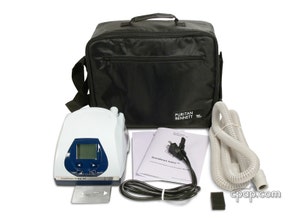
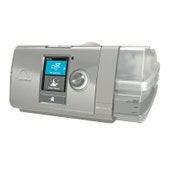
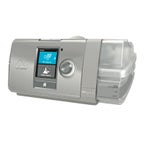
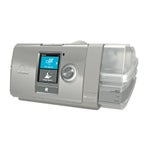
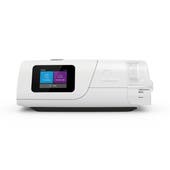
The Sandman Duo is lightweight, compact and user-friendly. The Duo BiLevel features an intelligent pressure stability and respiratory events detection system that reacts to an obstruction event. Also, the Sandman Series includes the humidifier technology called HumidControl. The built in humidifier actually measures the temperature outside the chamber and adjusts the heater plate to minimize condensation. At 2.64 pounds, take the Sandman Duo anywhere and feel confident you will receive effective therapy.
Manufactured by Puritan Bennett. 8% of BiLevel Machine product buyers choose this product.
This product no longer available and this information is for reference only. Newer Model Available: IntelliPAP BiLevel Machine with SmartCode.
| Pressure Range | 3-25 cm H20 |
| Flow Output | 190 LPM @ 20cmH2o |
| Ramp Time | 0-45 mins in 5 min increments |
| Starting Ramp Pressure | From 3cm up to CPAP pressure, CPAP-user-adjustable |
| Dimensions | 4.7"H x 6.9"W x 7.5"D |
| Weight | 2.2 lbs CPAP 2.64 lbs with humidifier and CPAP |
| Altitude Compensation | Automatic - maximum height 9000 feet. |
| Electrical Requirements | 100 - 240 AC, 12volt DC |
| Power Consumption | 50W Max without Humidifier, 90W max with humidifier at max setting |
| Noise Level | 26 dB at 1 meter with ISO17510-1:2002: |
| Maximum Power Consumption | 50W without humidifier, 90W with humidifier at maximum setting |
| Operating Temperature | 41°F to 95°F (5°C to 35°C) |
| Storage Temperature | -4°F to 140°F (-20°C to 60°C) |
| Dimensions: | Built-In |
| Weight (with water tank empty): | Approximately 2.4 Ounces (< 1kg) |
| Water Capacity | 350ml at recommended water level |
| Type of Protection Against Electric Shock: | Class II Equipment |
| Degree of Protection Against Electric Shock: | Type BF Applied Part |
| Equipment Type: | IPX1: Drip Proof Equipment |
| EMC Operation: | Continuous |
| Electromagnetic Compatibility: | The device meets the requirements of EN 60601-1-2, 2nd edition. |
| Heater Settings | 1 to 10 adjustable |
| Humidity Range: | Up to 40 mg H2O/l |
Associated Specifications | |
| Direct Battery Operation: Indicates which machines have a DC port in which you can use to connect a battery pack or a deep cycle marine battery with an optional DC cable. This is different from an integrated battery that works only with the machine it was designed for. (i.e. Everest CPAP Machine) see property Integrated Battery | Yes |
| Auto Altitude Adjustment: Altitude Adjustment is defined as the machine's ability to compensate for changes in altitude. Compensation can either occur manually or automatically. Manual adjustments occur within the Setup Menu and must be set by the user. Automatic requires no user intervention. | Auto |
| Auto Pressure Adjustment: This property defines whether the machine automatically adjusts pressure to meet the needs of the CPAP user on a breath-by-breath basis. All APAP machines are defined as 'Auto Adjusting', but some BiPAP's also use an Auto feature on both the IPAP and EPAP. If not marked, Yes, assume the machine does not have AUTO capabilities. | No |
| Heated Humidifier: This indicates which heated humidifier works best with the listed CPAP machine. In some instances, Built-in is used to describe a machine/humidifier combination system. The Fisher and Paykel HC150 was used for machines that do not have an integrated or built in humidifier system. | Built In |
| Manufacturer: This is the company that produces the product being compared. | Covidien |
| Advanced Software/Data: Identifies which machines are data capable and have the ability to track your therapy progress over time. The machine captures key metrics like AHI (Apnea/Hypopnea Index), Leakage, and most pressure used. Depending on the machine, the data can be retrieved through an on Machine Screen Display (MSD), through Optional Software (OS), and/or through SmartCode (SC). | MSD; OS |
| Travel Sized: Looking to travel? We have found some machines are easier to travel with than others. These smaller and more lightweight machines are still robust enough for constant daily use as well as travel. | Yes |
| Pressure Range: A CPAP (Constant Positive Air Pressure) delivers continuous airflow at a prescribed pressure at 4cm to 30cm. APAP operates between a range and BiPAP machines are a mix of ranges and constant pressures. This pressure is measured in centimeters of water pressure (H2O) and 4-20cm is average pressure range on most CPAP machines. | 4-25cm H2O |
| Voltage Range: Domestic Voltage is the voltage that is used with a standard wall outlet in the United States and ranges from 100-120 volts. International Voltage can range from 220v-240v AC. | 100-240V AC |
| Data Card: This property marks the machines that have the ability to record performance data on a removable card. Some machines that are flagged as having software (seeOptional Software), do not have removable memory cards, rather instead, records information on-board and must use a download cable to retrieve the data from the machine. | Yes |
| Auto ON/OFF: This feature turns the machines off and on when putting on or taking off the mask. When you put your mask on the machines senses you breathing and turns itself on. Take off the mask and the machine turns off. | No |
| Under 3 lbs: This measures only the weight of the machine and does not include total weight of power cables, bag, additional batteries or non-built-in humidifiers. | Yes |
| Built-In Humidifier: Identifies which CPAP has a humidifier that is built into the CPAP. Built-In humidifiers cannot be separated from the CPAP machine. | Yes |
| Type: This identifies the machine as continuous, auto adjusting, or bilevel operation. This does not identify whether the machine automatically adjusts pressure. Auto adjusting refers to APAP, whereas BiPAP Auto is differentiated using the Auto Pressure Adjustment property. BiPAP machines are defined further using Spontaneous or Timed properties. A CPAP machine blows one constant pressure of air into your passageway throughout the night. Your ideal pressure was determined during your sleep study. A BiPAP machine delivers two separate pressures of air; One when the patient inhales and a separate pressure when they exhale. The machine alternates between the two set pressures to help optimize your sleep apnea treatment. An APAP machine automatically adjusts on a breath by breath basis to blow the minimum pressure needed to keep your airway open during sleep. This allows your machine to provide you with your ideal pressure nightly. | BiPAP |
| Optional Software: Software is an option on some CPAP machines. The software can give details on compliance and performance. The patient or physician downloads the data from the CPAP machine to determine how long a patient has used their machine each night and how well the machine is working to stop Apnea/Hypopnea events. This property shows the software package to use for machine that has the ability to transfer data to your computer and report Hours of Usage. See Advanced Software for a list of machines that can report AHI or Leakage. | SandMan Therapy |
| Machine Weight: This is the actual weight of the CPAP Machine without any accessories, power cord, or humidifier. Machines with a weight 3lbs or less are also identified in the Under 3 lbs property. | 2.75 lbs |
| Optional DC Cable: A 'Yes' answer indicates that the CPAP Machine has an optional DC cable that plugs directly into a DC port (see _Direct Battery Operation_). This allows you to use a DC power source, such as a battery or car cigarette lighter. Although some cables already come with battery terminal leads, some DC cables will need a separate part that connects the cigarette lighter adapter to another adapter with terminal leads. | Yes |
| Warranty: Warranty is the length of time that the manufacturer will guarantee a product to be free of defects. Warranties vary in length depending on manufacturer, but generally all machines come with a 2 Year Warranty. | 2 Years |
| Mask Off Alert: This feature detects excessive mask leaks due to poor cushion seal or when a user stops therapy by removing a mask when in use. The alert can be in the form of an audible alarm (ALARM) or a text message on the unit's LCD display (LCD). | LCD |
| EPAP Pressure Range: This Property lists the operating range for the Exhalation Positive Airway Pressure (EPAP). This is the pressure setting used when you exhale. EPAP is always lower than the IPAP (inhalation) pressure, making breathing out easier and more comfortable. | 3-25 cm H20 |
| Heated Humidifier Type: This property identifies how the machine incorporates a Heated Humidifier. āBuild Inā humidifiers are built into the CPAP machine and cannot be separated from the machine. āIntegratedā humidifiers connect directly to the CPAP machine and they can only be used with compatible CPAP machines. With āIntegratedā humidifiers, the CPAP machine, can be separated and used without the humidifier. CPAP machines that do not have a built in humidifier and do not have an integrated humidifier option have to use a āStand Aloneā humidifier as the machineās heated humidifier option. āStand Aloneā humidifiers can be used with any machine and connect to the CPAP machine with an additional hose. | Built In |
| Integrated Battery: An integrated battery pack attaches to and functions seamlessly with the machine it is integrated with. It allows your CPAP to run on AC and fail over to the DC battery only if necessary. | No |
| Easy Breathing: Pressure Relief is a feature that lowers your therapy pressure to help with difficulties breathing against the machine's airflow, providing a more comfortable and natural breathing pattern. Assistance can occur on the Exhalation, on the Inhalation, and on both exhalation and inhalation at the same time. | No |
| RainOut Reduction: Manufacturers are finding ways to reduce the amount of water that collects in the CPAP hose when using a Heated Humidifier. The Rainout Reduction feature varies by manufacturer and machine and can be anything from an integrated heated hose, to technology that measures the humidity at the mask and adjusts the humidity to reduce rainout. | No |
| Entire Weight: This is the combined weight of the machine, heated humidifier, power cables, bag and hose. | 5.10 lbs |
| Sound Level: This is the level of sound the machine produces at a pressure of 10cm, standing 1 meter away or roughly 3 feet from machine. Measured in Decibels, the values also indicate whether the machine is considered a "quiet CPAP"; see Quiet property. | 26 dB |
| Spontaneous: Spontaneous (S) mode tells the machine to start blowing at IPAP pressure with no specific interval set. The machine must wait and detect a break in the breathing cycle before reacting, switching from exhalation to inhalation. If a backup rate is needed, then the unit will need a time interval setting and will be marked 'Yes' on the Timed property. | Yes |
| Ramp: The Ramp feature allows the user to start treatment at a lower pressure to fall asleep with, gradually raising the pressure over a set time. This is a comfort setting and can set from 0 to 45 minutes on most CPAP machines. | Yes |
| Entire Size: This is the combined dimensions of the CPAP with the Heated humidifier. | 6.9" x 7.5" x 4.7" |
| Timed: Timed (T) or Spontaneous Timed (ST) modes provide a customizable backup rate that forces the machine to switch from exhalation to inhalation. In ST Mode, the machine monitors the breathing cycle and switches from EPAP to IPAP once the backup time is met or whenever the break is detected through the sensors; whichever occurs first. The time aspect is only meant to act as a backup respiratory rate to the (S) function (see Spontaneous). This is used for patients with central sleep apnea, or those who need non-invasive mechanical ventilation. | No |
| Quiet: This identifies which machines have a decibel rating of 28 and lower. This does not account for use with the humidifier attached, which could supply additional volume that can muffle or amplify sound. This property does not account for noise that travels through the CPAP tubing, seemingly sounding louder than the measured db rating. | Yes |
| Entire Package Size: This is the size of the CPAP with Heated Humidifier in its travel bag. | 11" x 5.5" x 13.8" |
| Manuals Included: This indicates which manuals are included with the purchase of a CPAP machine. Most all machines come with a patient manual; also called 'user manual', which may or may not have pressure setting instructions. Some machines come with both the patient and quick setup guide or both patient and clinician manuals. | Patient/Clinician |
| CPAP Mode: This property defines whether the machine is capable of continuously blowing a constant pressure. All CPAP machines are defined as 'continuous', but some BiPAP's and APAP's also come with a CPAP mode; some BiPAP and BiLevel machines Do NOT. By setting the IPAP and EPAP to the same pressure, a CPAP Mode is achieved, preventing the EPAP pressure from dropping. | IPAP=EPAP |
| Machine Size Only: Measures the overall dimension of the machine only. Machines with a built-in humidifier are marked NA and must refer to Entire Size dimensions. | NA |
"I have been on Cpap/Bipap for 8 years+. I had another failure of my Respironics BiPap again contacted the company the sold me it and the gave me a loaner the M series unit. I got back my machine only to have it fail again. I ordered this machine that I have been on for the End of August. This is the best machine I have ever used. Smooth air flow does not stop before you finish inhaling. I have had more steady sleep in years. Even if I wake up I am back to sleep in minutes I would recommend this machine over Respironics any day. The best I have tried."
"The Sandman Duo is a very quiet and effective BiLevel. It takes up very little space on my nightstand. I am sleeping much better than with the Puritan 425 BiPaP. I hope the build quality is equal to the machine's performance."
We provide our customers with many tools to make informed decisions about their machine purchases. Options include:
We work very hard to provide many different ways for our customers to compare products. Here are the machine product guides we have created and maintain:
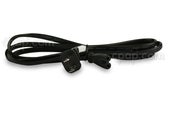
Machines come with a six foot hose, power cord, at least one filter, and manuals. Most manufacturers include a carrying case which is designed specifically for their equipment. CPAP / BiPAP / APAP machines do not come with a delivery system or mask. CPAP Masks must be purchased separately.
To see the list of what specifically comes with each machine, you can browse for a machine. Then on the product page, click the "Specs" tab to see a full list of what comes with the machine.
All CPAP masks work with all machines.
Yes. Federal law requires we have a valid prescription on file before we ship your mask, machine and/or humidifier.
We provide many easy ways to get your prescription:
Exhalation relief is a comfort feature offered by two manufactures which reduces the air flow at the time of exhalation making the breathing process more natural.
Many PAP users experience nasal congestion and dryness of the nose and throat during treatment. This is especially problematic for new users adapting to the treatment. Humidification adds moisture to the air, reducing systems of dryness and congestion.
Nasal congestion also leads to mouth breathing, which perpetuates the problem of dryness. If this is an issue for you, try a heated humidifier.
An integrated humidifier is a component to a specific CPAP that fits directly to the CPAP, eliminating the need for a second hose and in some heated humidifiers, a second power cord.
The advantage of an integrated humidifier is a more compact unit that uses fewer parts.
A disadvantage is that they may produce less moisture if used as passover humidifiers because the surface area is typically smaller. Also, most integrated humidifiers will function only with the CPAP for which they were designed.
You can see if your machine has an integrated humidifier option by reviewing our compare charts.
An example of an integrated humidifier is the PR System One Heated Humidifier as seen below attached to one of the PR System One line of CPAP machines.

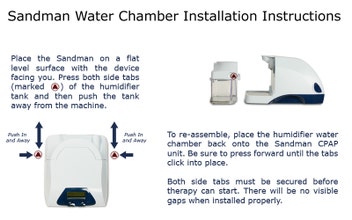
A "built in" humidifier is designed so that it is part of the CPAP machine and cannot be removed or separated from the CPAP machine. This is similar to an all-in-one unit eliminating the need for a second hose or second power cord. Usually the water chamber can be removed for cleaning or replacement purposes.
The advantage of a "built-in" humidifier is a more compact unit that uses fewer parts. This design also helps to ensure therapy effectiveness by including the heated humidifier which may provide comfort to the CPAP user they may not have received otherwise.
A disadvantage is that they may produce less moisture if used as passover humidifiers because the surface area is typically smaller. Also, since the humidifier is "built in" to the machine, the ability to detach the humidifier is not an option. This can be an issue for frequent travelers. Lastly, if the machine or humidifier stops working, the entire unit must be sent in for repair or replaced, not just the component that failed.
An example of a machine with a built in humidifier is the Sandman Info HC CPAP Machine with Built In Heated Humidifier as seen below.
The only care the humidifiers require is that you empty and clean the water tank after use in the morning. Be sure to use distilled water only in the tank.
A BiPAP, also referred to as a Bi-Level or VPAP, alternates blowing two set pressures, a higher pressure for inhalation and a lower pressure for exhalation.
A BiPAP ST Machine is a non-invasive ventilator. ST stands for Spontaneous Timed.
A BiPAP has two set pressures but some patients require a back up timed response in which the BiPAP will initiate a breath if a breath is not taken within the set timed parameters.
For example, a BiPAP ST might be set with an inhale pressure of 10 and an exhale pressure of 5 with a BPM (BPM=Breath Per Minute) of 12. A BiPAP ST will not breathe for you but will initiate a breath if you do not inhale 12 times a minute.
A heated humidifier uses heat to produce moisture. The heat is adjustable for more or less moisture, and the chamber is much smaller than a passover humidifier.
It is our experience from over ten years of specializing in CPAP equipment, that patients who use heated humidifiers have a much higher rate of therapy effectiveness to CPAP therapy.
There are three types of heated humidifiers:
A passover humidifier is a chamber of water added to the CPAP to help moisten the airflow and reduce irritation to the nasal passages.
Air flows from the CPAP, through a short hose to the humidifier, then into the six foot hose to the mask. The air picks up whatever moisture it can as it "passes over" the water in the chamber.
Passover humidifiers may provide sufficient moisture with CPAPs set at lower-end pressures, but if not, there is no way to increase the amount of moisture produced. Furthermore, in cold climates, the water temperature in the chamber will drop, causing the CPAP air to become very cold and reduce the amount of moisture.
A stand-alone humidifier is a component that will work with any CPAP and does not attach directly to the CPAP. It uses its own power cord and typically a short hose is used to connect it to the CPAP. Usually it would sit next to the CPAP machine and is slightly larger than an integrated humidifier.
The advantage of a stand-alone humidifier is superior humidity and control and often a larger water capacity with the chamber. Also, the fact they may be used with any CPAP machine can be useful.
The main disadvantage is that the size is often larger than either a "built in" or integrated humidifier with the short hose are needed to connect it to the CPAP machine.
An example of a stand alone humidifier is the Fisher & Paykel HC150 Heated Humidifier as seen below.

Rainout is the accumulation of water in a CPAP tube due to warm moist air cooling on its way from your CPAP machine to your CPAP mask.
The image below from Fisher & Paykel explains how rainout is formed. Warm moist air leaves the heated humidifier and travels down the CPAP tube. As the air travels down the tube the room temperature can cool the tube and therefore cool the air traveling down the tube. As the air cools, the air released its moisture and condensation occurs, otherwise known as rainout.
Solutions to rainout include:
Using distilled water helps keep your humidifier clean and mineral deposit free. If you were to use tap water, the water would evaporate to leave a hard white mineral deposit in your tank or lead to mold growth. Cases of lung disease have been connected to using contaminated well water in a CPAP humidifier.* Source
If you can't get distilled water where you live, use bottled water. You will need to rinse your tank out each morning and do not leave standing water in your tank between uses.
The only care required for machines is to clean or change the filters at the air intake of the machine to keep the internal parts from accumulating dust.
There are other suggested actions to care for your machine:
CPAP therapy provides a constant airflow which holds the airway open so that uninterrupted breathing is maintained during sleep. It is traditionally provided through a nasal mask that seals around the nose to maintain the pressure level.
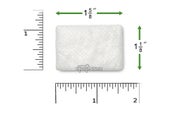
Yes, all CPAPs use at least one filter that is usually a type of foam material and washable. Some CPAPs offer finer filtration with the addition of a disposable paper filter.
Cleaning and changing filters is the only maintenance required for a CPAP machine.
The filters are located at the back of the machine at the air intake. The image below shows the black foam filter at the back of the Everest 3 CPAP Machine.
CPAP machines which record full data (like AHI and leak info):
CPAP software allows the downloading of information from certain CPAP machines. Information on breathing, pressure levels delivered, apneas, etc. is available to help determine the effectiveness of CPAP therapy. Software is not required to operate a CPAP machine. CPAP Software also provides more data than obtained through the on screen display or SmartCode. The CPAP Software also allows you and your doctor to drill into any night of data recorded and view the data on an hour by hour basis.
Some CPAP manufacturer maintains a proprietary software package that is only compatible with their machines.
Here is a list of each manufacturer and the name of its related full data software:
There are two types of software available: Compliance software, and Advanced software.
Compliance software provides data such as patient hours, total machine operating hours, your pressure setting, and pressure relief information. Advance software includes compliance data and provides more detail such as AHI (Apnea/Hypopnea Index), Leakage, most pressure used, and a detailed usage histogram.
Compliance software is available with some standard CPAP machines. Advanced software is available with most top of the line CPAP machines, APAPs, and Bi-level machines as well.
Software data can be interpreted by your physician or clinician. There are also many websites and search engines available to help you research the sleep apnea related terms which will provide you more knowledge in managing your own cpap therapy. CPAPtalk.com. our free Sleep Apnea forum is a great resource for CPAP users who want to understand their condition and take control over their health.
Visit the Learning CenterGet the latest news on CPAP care and hear about special deals and offers.
Copyright © 1999 – 2010 US Expediters, Inc. All Rights Reserved.